December 2024

1

1a

2

3

[Urushi]

Urushi has been believed to have special powers since ancient times and has been valued as an amulet against evil. It is believed that urushi has the power to keep evil things away from the food and water in lacquerware because of its resistance to decay and the severe rash it causes when touched by its sap. Monks practicing Zen meditation at Zen temples use black lacquerware called 'oryoki (応量器)' to eat their meals, and rinse the bowls with tea after each meal to keep them clean. Osechi dishes are stored in lacquered stacked boxes for several days. Urushi has strong adhesive and antibacterial properties, and research has shown that E. coli bacteria on lacquerware are almost completely killed after 24 hours. Because of its safety, protection, robustness, and aesthetic qualities, urushi is used in vermilion-lacquered buildings in China and Southeast Asia, as well as in shrines and temples in Japan.

Urushi is a natural resin paint obtained by refining the sap from scratches on the inner bark of the trunk of the urushi tree. Urushi dries at 25°C (77°F) and 70% humidity. Urushiol, the main component of urushi, incorporates oxygen through the action of the enzyme laccase, and polymerizes and hardens. The dried and hardened urushi coating has a unique soft texture and beautiful color and gloss. The more one uses urushi, the more brilliant it becomes, and as the years go by, the more transparent it becomes, and the more vivid the color urushi becomes.

Urushi has been used since the Jomon period, but today only a few percent of the urushi used in Japan is domestically produced, and most of it is said to be foreign. The spread of plastic paints and the rise of inexpensive imports in the postwar period have led to a sharp decline in domestic urushi production. It takes 10 to 15 years to extract urushi from a urushi tree, and a urushi craftsman can collect only about 200 ml of urushi from one tree in six months. It takes a long time and the skill of a craftsman to restore domestic urushi.

The habitat of poison ivy is limited to East and South Asia, and lacquerware became an important export to the West during the Age of Discovery. Marie Antoinette was a collector of lacquerware, and her mother, Maria Theresa, once said, 'I would rather have lacquerware than diamonds,' even having a 'urushi room' in her palace in Vienna. In the 17th century, a painting technique called “japanning” developed in many European countries. Pianos, which were usually finished with a wood-grain finish, were influenced by this japanning technique and were painted black.

Urushi is used in all its forms, including leaves, flowers, fruits, shoots, branches, and bark. For example, fruits can be roasted to make coffee, flowers can be used to make honey, and shoots can be eaten as tempura. The main ingredient of urushi is a Chinese herbal medicine called “kanshitu (干漆)” which is used for parasite extermination and to improve blood stagnation. In Korea, urushi has long been used as a medicinal herb to boost immunity, treat joint pain, and act as a stomachic. There is a herbal dish called “otgyetang (漆鶏湯),” which is made by boiling the bark of the urushi tree (from which the poison has been removed) and chicken meat together, similar to samgyetang.

Urushi is also known as “the paint closest to human skin.” Lacquerware has an excellent feel and mouth feel, and its lightness and the warmth unique to wood are attractive. In terms of handling, since lacquerware is sensitive to drying and sunlight, it should be washed quickly and rinsed well after use, and the moisture should be wiped off immediately. Lacquerware is one of Japan's representative traditional crafts, and we hope to preserve its tradition by using it carefully for years to come.

Appi Urushi Studio's Jubako
https://www.shokunin.com/en/appi/jubako.html

References
https://kakikofu.com/knowledge/kampo/漆と漢方薬と漆器のある暮らし/
https://www.9emon.co.jp/post/urushi_eat
https://www.yamakyu-urushi.co.jp/shikki/237_240/
https://okushizuurushinosato.com/
https://urushi-joboji.com
http://urushiart.com/about_urushi.html
https://urushi-joboji.com/urushi

1

2

[Enjoying Meals with Small Dishes]

I made my favorite butter chicken curry today. Normally, I serve a large dish with plenty of rice and roux, and I usually have a second helping, but today I dared to choose a “small dish.”

It's amazing how a small dish naturally allows you to serve less, and furthermore, when you see the food filling the dish and your eyes, both your eyes and your brain feel satisfied that it's enough. For me, as a member of a generation that wants to be more health-conscious by now, this may be an opportunity to not only curb my overeating, but also to think about the proper amount of food that does not put a burden on my body. I felt that it was a good idea.

Once you have a smaller main dish, the next step is to devise the accompanying dishes so that you can be aware of the overall quantity and nutritional balance. When you eat while feeling whether you are eating a well-balanced meal and whether there is any nutritional deficiency, you can better experience the connection between your health and your daily diet, and you will naturally feel more appreciative of food. Eating with an awareness of “just a little bit of what you want to eat” is likely to become a habit that is kind to both your body and your mind.

The small action of “changing the dish” can create a change in one's habits as well. A small size that may be a little small for your main use may actually be perfect for you. The year-end and New Year holidays provide more opportunities to enjoy food, and we encourage you to take this opportunity to try out “small dishes.”

Seiryugama's Kobachi L
https://www.shokunin.com/en/seiryu/kobachi.html
Ichiyougama's Plate
https://www.shokunin.com/en/ichiyou/plate.html

S__154402820

S__154402822

[Gyoza with Miso Sauce - A Taste of Kobe]

Gyoza with miso sauce, said to have originated in Kobe, is a beloved comfort food for locals of Kobe and is recognized as a regional delicacy. Its addictive flavor pairs perfectly with beer.

While yaki-gyoza is usually eaten with vinegar, soy sauce, or raayu (Chinese chili oil), Kobe has a food culture of eating gyoza with miso-based sauce. The originator of this culture, "Ganso Gyozaen" (元祖 ぎょうざ苑), established in 1951 in Nankinmachi, is considered to be the originator of gyoza with miso sauce. At that time, before World War II, Japanese people living in Manchuria preferred yaki-gyoza (grilled dumplings) to the sui-gyoza eaten by the Chinese, and many families ate them with miso sauce out of nostalgia for their hometown. After the war, the grandfather of Ganso Gyozaen's founder, Korosue, wanted to spread the gyoza he had eaten in Manchuria in Japan, so he opened a restaurant and served yaki-gyoza with miso sauce, which then spread to other restaurants.

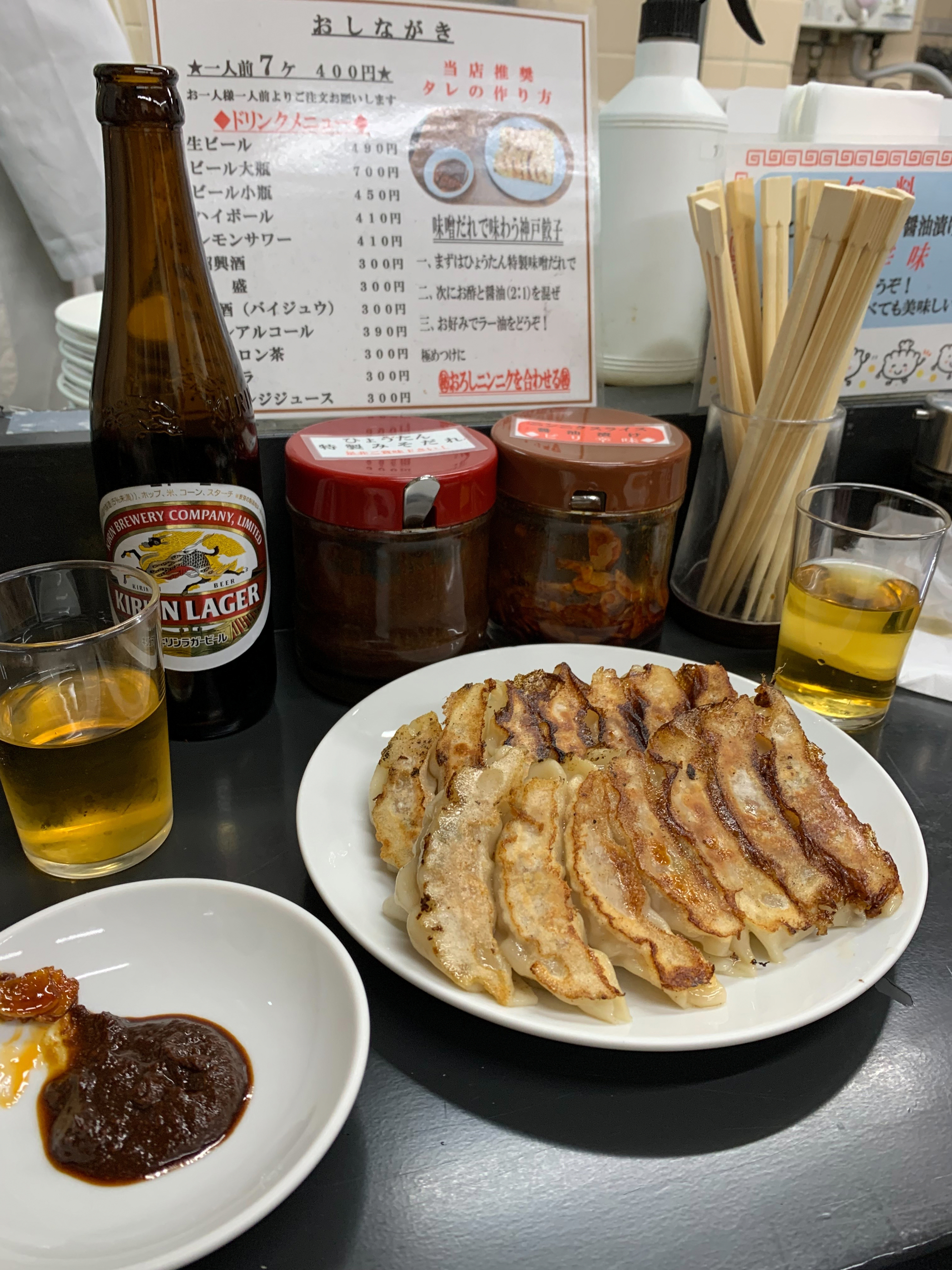
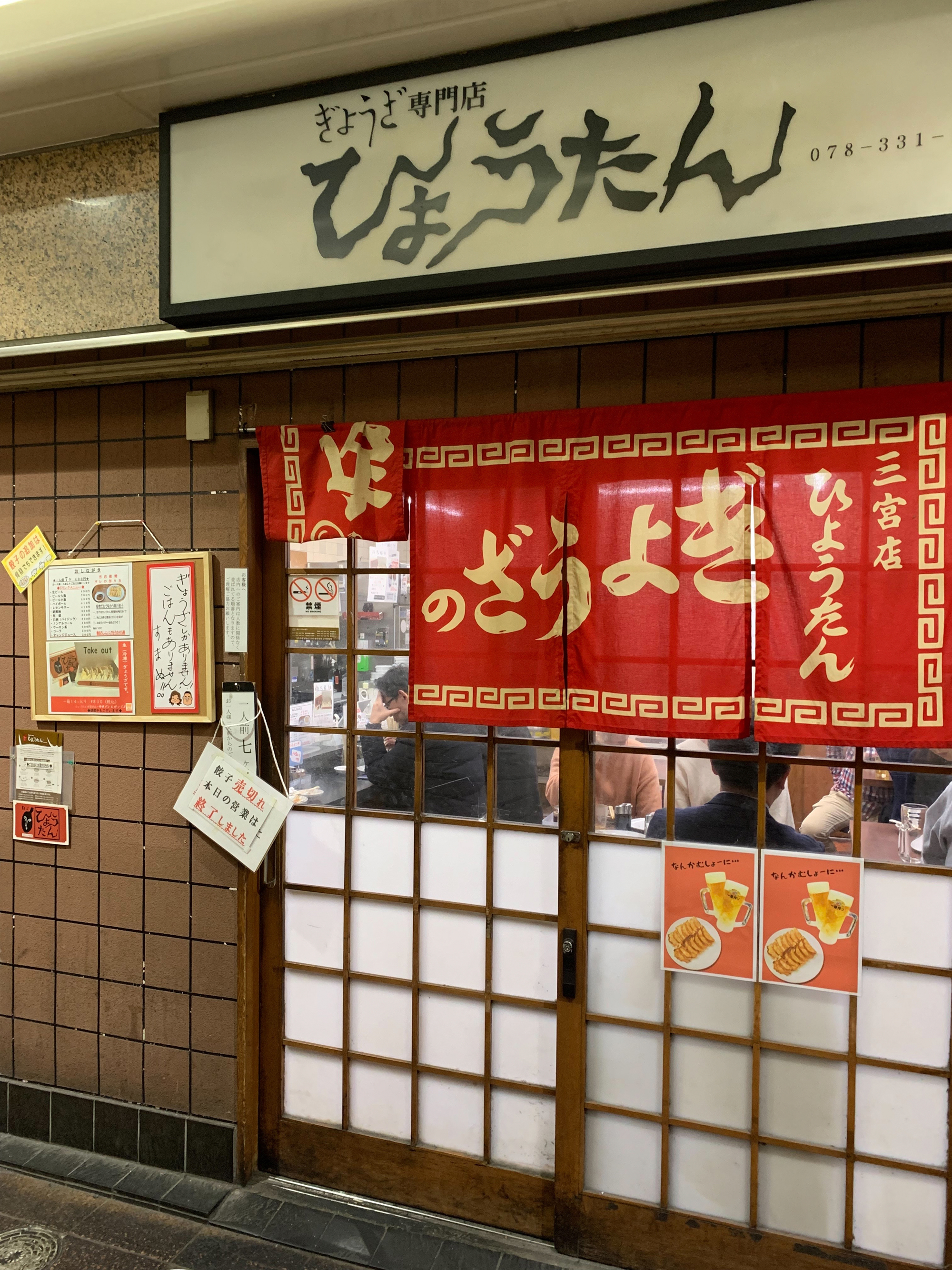
There are a number of restaurants in Kobe that serve gyoza with miso sauce, but I always stop by "Gyoza no Mise Hyotan Sannomiya-ten" (ぎょうざの店 ひょうたん 三宮店), which was established in 1957 and serves only yaki-gyoza. When you order gyoza, the staff entrusted with the grilling area, who have mastered the method handed down from generation to generation, will grill the gyoza for you. On the table is a spicy garlic slice in soy sauce, which does a great job. While waiting for the dumplings, we first sip a beer while nibbling on the garlic slices. On this particular day, the smell of garlic is not an issue.

When the beautifully browned gyoza arrive, they are first dipped in Hyotan's special miso sauce, an original blend of ground meat and other ingredients based on red miso paste. The sauce is thick but not salty and has a delicious flavor that makes the gyoza and beer go down a treat. We like the usual gyoza with more vinegar, but we can't help but think this is good too. You can order a second plate of gyoza with vinegar, soy sauce, raayu (Chinese chili oil), or grated garlic if you like, because one plate will be gone before you know it.

Each restaurant has its own unique taste, such as red miso, white miso, or combined miso, so we recommend that you go on a tour of miso-drenched gyoza restaurants when you visit Kobe. We hope you will find your favorite one.

ぎょうざの店 ひょうたん 三宮店
https://maps.app.goo.gl/7j3S3ndHdYhTA1Vr5
元祖 ぎょうざ苑 神戸南京町・中華街店
https://maps.app.goo.gl/qzNfWZ4zCJZcVba86

References
https://www.maff.go.jp/j/keikaku/syokubunka/k_ryouri/search_menu/menu/40_18_hyogo.html
https://www.feel-kobe.jp/column/misodare/
https://hyoutan-kobe1957.com/
https://www.feel-kobe.jp/model_course/%E7%A5%9E%E6%88%B8%E3%81%8C%E7%99%BA%E7%A5%A5%EF%BC%81%E5%91%B3%E5%99%8C%E3%81%A0%E3%82%8C%E9%A4%83%E5%AD%90%E3%81%AE%E6%9C%89%E5%90%8D%E5%BA%97%E3%82%81%E3%81%90%E3%82%8A/